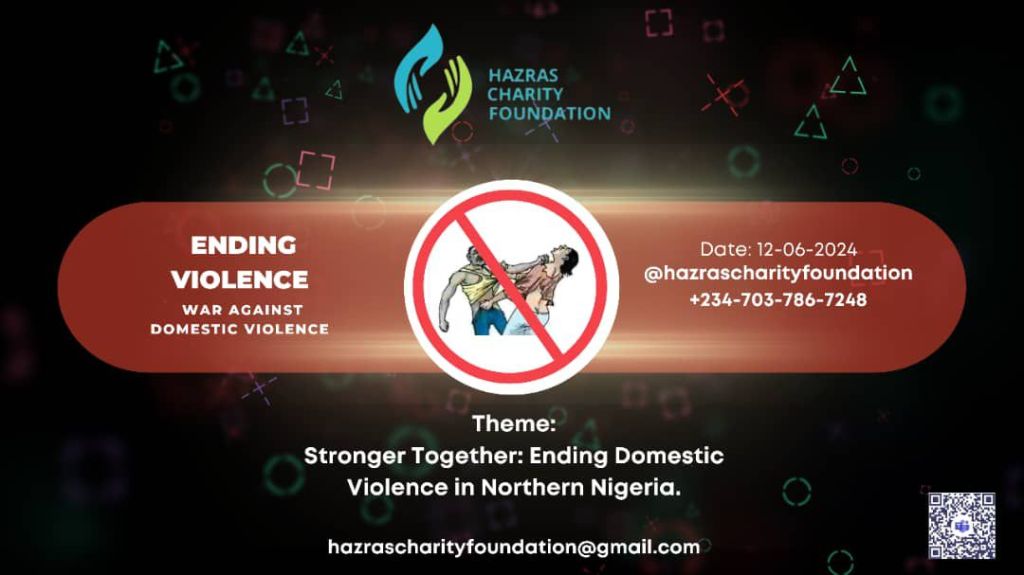
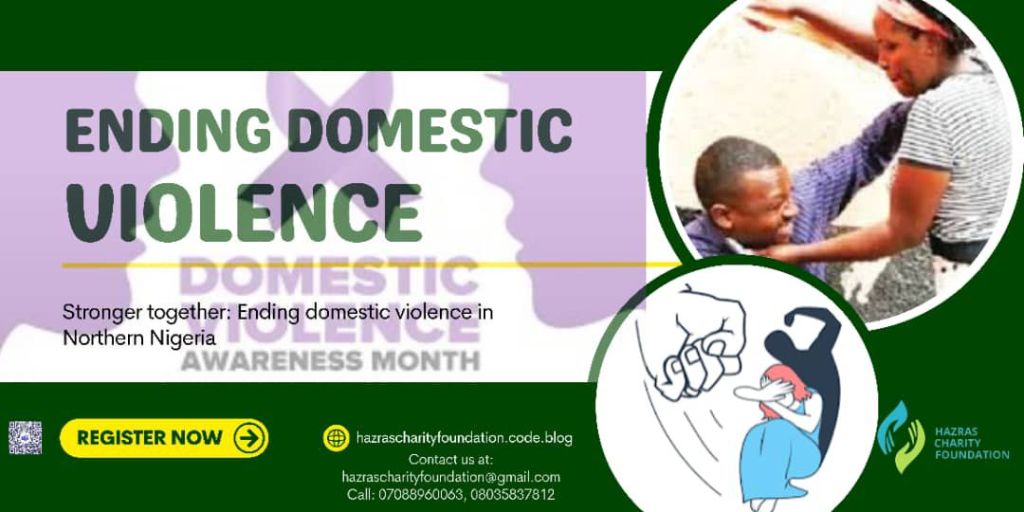
Project Report: Stronger Together: Ending Domestic Violence in Northern Nigeria
Submitted by: Hazras Charity Foundation
Introduction
The Hazras Charity Foundation (HCF) launched the “Stronger Together: Ending Domestic Violence in Northern Nigeria” program to address the pervasive issue of domestic violence in the Northeast, Northwest, and Northcentral regions of Nigeria. This comprehensive capacity-building initiative aims to raise awareness, strengthen support systems, promote legal literacy, engage communities, and provide essential resources to combat domestic violence effectively.
Objectives
1. Raise Awareness: Educate communities about the signs, consequences, and prevention of domestic violence.
2. Strengthen Support Systems: Enhance the capabilities of local organizations, social workers, and law enforcement in supporting victims.
3. Promote Legal Literacy: Inform community members about their legal rights and protections against domestic violence.
4. Foster Community Engagement: Encourage active participation from community leaders, religious figures, and local influencers in advocating for a violence-free society.
5. Provide Resources: Equip communities with tools and resources to combat and reduce domestic violence effectively.
Program Structure
1. Awareness Campaigns
– Public Workshops and Seminars: Interactive sessions were conducted to educate communities about the causes, effects, and prevention of domestic violence.
– Media Outreach: Local radio, television, and social media platforms were utilized to disseminate information and share personal stories of resilience and recovery.
– School Programs: Educational programs were introduced in schools to teach young people about healthy relationships and conflict resolution.
2. Training and Development
– Workshops for Professionals: Specialized training was provided for social workers, counselors, and law enforcement officers on handling domestic violence cases sensitively and effectively.
– Community Leader Training: Religious leaders, traditional rulers, and community heads were empowered with knowledge and skills to mediate conflicts and support victims.
3. Legal Support and Advocacy
– Legal Literacy Campaigns: Sessions were offered to educate the public about their legal rights and the legal avenues available for protection against domestic violence.
– Policy Advocacy: Efforts were made to work with policymakers to strengthen laws and policies that protect victims and hold perpetrators accountable.
4. Support Services
– Counseling and Therapy: Support centers were established to provide psychological counseling and therapy for victims and perpetrators.
– Shelters and Safe Houses: Safe spaces were set up where victims could seek temporary refuge and support while they rebuilt their lives.
– Hotline Services: Confidential helplines were launched to offer immediate assistance and referrals for victims of domestic violence.
5. Monitoring and Evaluation
– Data Collection and Analysis: Mechanisms were developed to track the prevalence and impact of domestic violence in target regions, assessing the effectiveness of interventions.
– Feedback Mechanisms: Platforms were created for community members to provide feedback and suggestions for improving the program.
Implementation Plan
Phase 1: Needs Assessment and Planning (Months 1-3)
– A thorough needs assessment was conducted in each region to identify specific local challenges, resources, and stakeholders.
– Detailed implementation plans were developed with input from local stakeholders.
Phase 2: Awareness and Training Initiatives (Months 4-8)
– Awareness campaigns and educational programs were launched.
– Training sessions were conducted for professionals and community leaders.
Phase 3: Support Services Establishment (Months 9-12)
– Counseling centers, shelters, and hotline services were set up.
– Direct support to victims of domestic violence began.
Phase 4: Monitoring, Evaluation, and Scaling (Months 13-18)
– The impact of the program was evaluated, and strategies were adjusted as needed.
– Successful initiatives were scaled to additional communities and regions.
Budget
The budget for this project covered the following key areas:
1. Awareness Campaigns: $50,000
2. Training and Development: $100,000
3. Legal Support and Advocacy: $40,000
4. Support Services: $150,000
5. Monitoring and Evaluation: $30,000
Total Estimated Budget: $370,000
Expected Outcomes
– Increased awareness and understanding of domestic violence and its impact.
– Strengthened support networks for victims and communities.
– Enhanced capacity of local organizations and law enforcement to address domestic violence.
– Improved legal literacy and access to justice for victims.
– Reduction in the incidence of domestic violence in the target regions.
Conclusion
The Hazras Charity Foundation remains committed to ending domestic violence and creating safe, supportive communities where all individuals can thrive. The “Stronger Together: Ending Domestic Violence in Northern Nigeria” program has made significant strides in empowering communities, strengthening support systems, and promoting a culture of non-violence. Continued collaboration with local and international partners will be crucial in sustaining and expanding these efforts, ultimately building a future where every individual can live with dignity and respect.
Contact Information
For more information or to support this initiative, please contact:
Hazras Charity Foundation
Number 2 Aminu Kano Road,
Kano State, Nigeria
Email: hazrascharityfoundation@gmail.com
Phone: +2347088960063, +2348169627766

 Hazras Charity Foundation
Leave a comment